






The National Education Policy 2020 articulates a clear goal that every child in the range of 3-8 years must have a free access to free, safe, high quality, developmentally appropriate ECCE by the year 2025.The first eight years of a child’s life are truly critical and lay the foundation for lifelong well-being, and overall growth and development across all dimensions -physical ,cognitive , and socio-emotional. Driven by the guiding principles of NEP 2020:
- Early Brain Development: The pace of brain development is more rapid than any other stage of a person’s life. The NEP stresses that 85% of brain development occurs by the age of 6. SMS integrates this by promoting activities that enhance cognitive abilities, creativity, and social-emotional skills in every aspect of curriculum.
- Holistic Development: Powered by NEP 2020 and complemented by insights rooted from the ancient wisdom of the Pancha kosha — the five sheaths of human development, our approach at SMS honours the wholeness of every child. When we see children through the Panchkosh lens, we understand that learning is not just about numbers or letters — it’s about movement, breath, love, thought, and joy. It’s about nurturing not just a student, but a human being in bloom. The holistic development of a child considers the nurturing and nourishment of these five layers. Nurturing each kosha during the formative years (ages 3-8) lays the groundwork for sustained learning and wellness is what we will discover together.
- NIPUN: Foundational Literacy and Numeracy: According to NEP 2020, highest priority is to be achieving Foundational Literacy and Numeracy by all students by Grade 3. SMS supports this through Reading programs, Hands on numeracy activities using play-based activities and structured exercises that encourage pre-writing skills.
- Multilingualism and the Power of Mother Tongue: The National Education Policy (NEP) 2020 strongly emphasizes the use of the mother tongue or home language as the medium of instruction, especially in the Foundational Stage (ages 3–8). It promotes multilingualism to help children build strong cognitive and linguistic skills. Teaching in the language children understand best ensures deeper learning, better participation, and emotional connection. At SMS, our teachers conduct story telling sessions, puppetry, rhymes and group discussions in multiple languages to support multilingual Growth.
- Inquiry Based Learning – Igniting Curiosity: The NEP 2020 promotes inquiry-based, discovery-oriented, and learner-centered pedagogy at the Foundational Stage to foster curiosity and exploration. At SMS, we encourage learning through play, activity, and hands-on experiences rather than rote methods. Children are encouraged to ask questions, explore the environment, and discover new learning for themselves, laying the foundation for critical thinking and problem-solving. The focus is on making learning joyful, engaging, and meaningful in the early years.
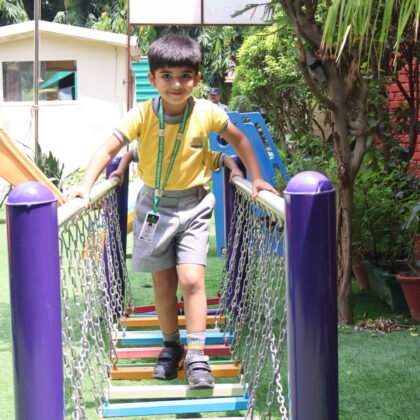
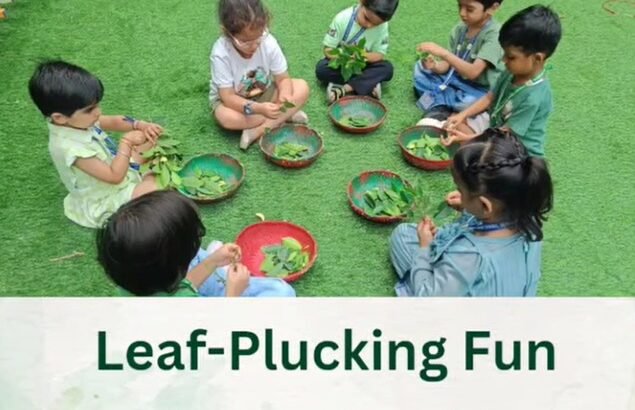
- Experiential learning, as emphasized in NEP 2020, is central to the Foundational Stage, promoting learning through real-life experiences, play, and hands-on activities. At SMS, we implement learning by doing—engaging with their environment through stories, role play, art, movement, yoga free play and exploration. We integrate Arts and Sports into our curriculum. It also supports the development of life skills, values, and socio-emotional growth in early learners.
- Health and Hygiene: Health is integral in our school. At SMS, we implement healthy routines and habits in daily routine. Children are taught the importance of healthy eating and developing habits through discussions and workshops.
- Toy and Play Pedagogy: Children learn best through play-through activity and doing. At SMS, we engage children in play, play is a child’s work. They are learning, learning to make sense of the world, learning to solve problems, learning about themselves and others. Choice, wonder, and joy are key aspects of children’s play in our school environment and our classrooms are organised around these three aspects.
- DIKSHA- Teacher’s empowerment: Our school invests in continuous teacher training through Diksha platform, CBSE, In-house training sessions ensuring child-centric learning and updating on the latest developments in early childhood education.
- PARAKH- Comprehensive Assessments: Assessments at SMS go beyond traditional testing and we follow 360-degree assessment to understand the learning achievement of children. Child’s progress is tracked against each competency. Children can progress from one stage of growth to another at a pace they are comfortable with.
Conclusion
By adding ‘Foundational Stage’ to the formal school system, the NEP 2020 has laid foundations of holistic, fun-filled, stress free, uniform, child-centred learning for all early learners in India. SMS curriculum is a shining example of how NEP 2020’s principles can be effectively incorporated into early childhood education. For our prospective parents, SMS is an ideal choice that aligns with the latest educational reforms while ensuring a strong academic and moral foundation for their children.
Latest Updates
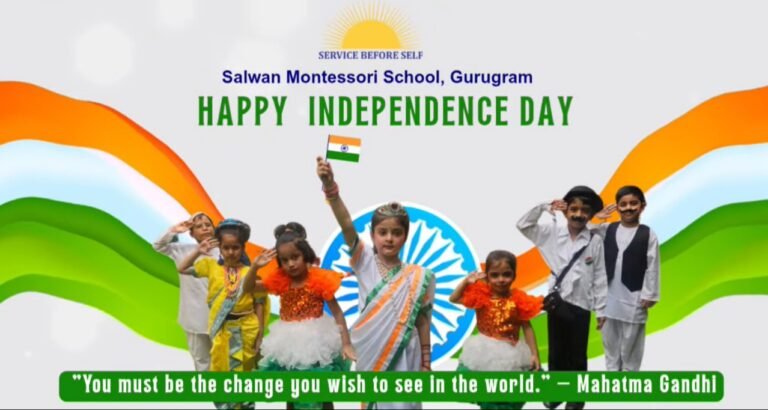
79th Independence Day Celebrations
School Admission
Founded in 1999, Salwan Montessori School, Gurgaon is an English medium coeducational preschool.